

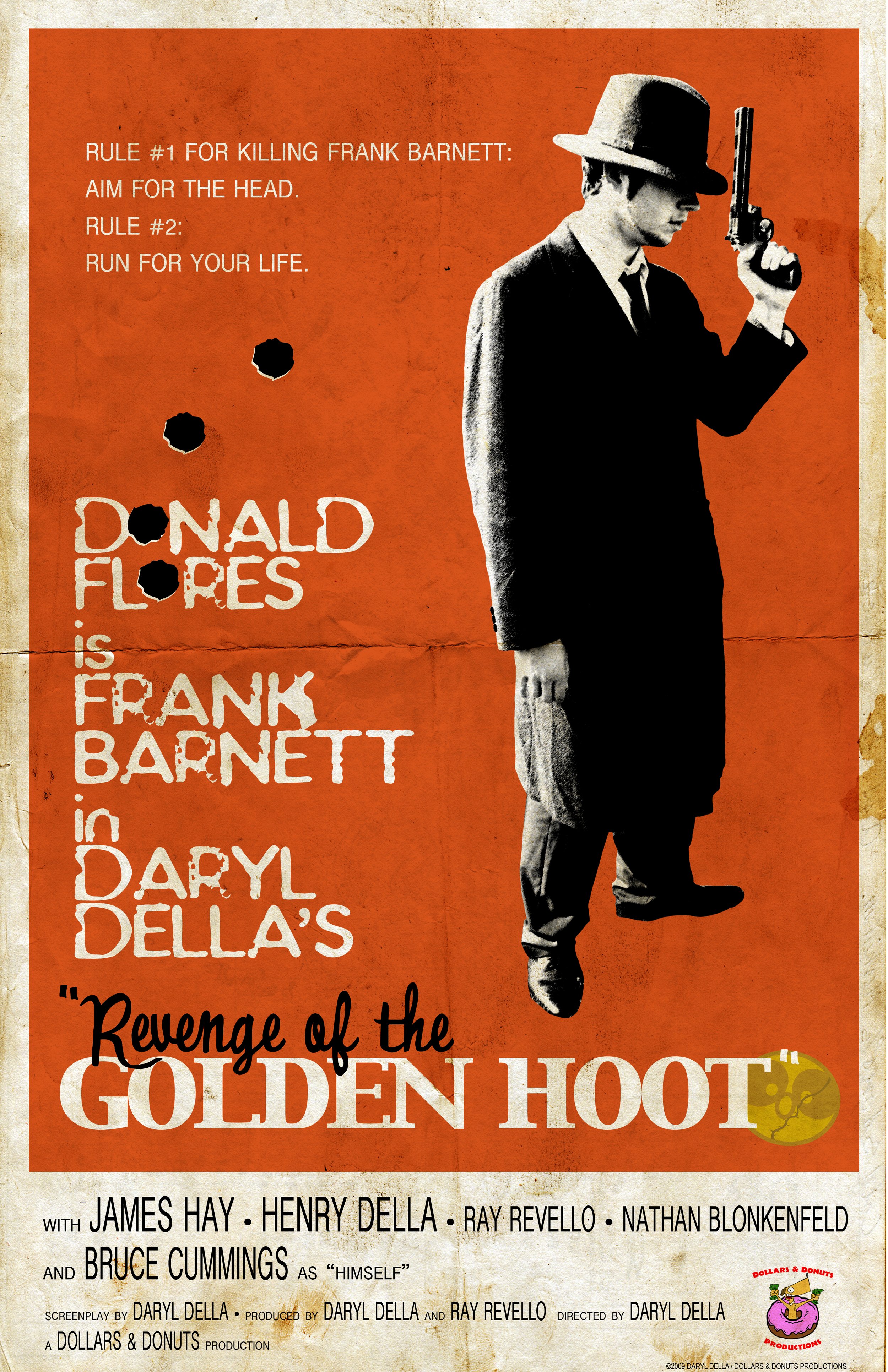
After stepping away from detective work, Frank Barnett is trying to live a quieter life as a flower delivery driver. That ends abruptly when he’s attacked on his route by a group of men searching for a relic known as the Golden Hoot. At the same time, Bruce Cummings, the Librarian Extraordinaire, is being held captive and tortured by the same group, who believe he knows where the artifact is hidden. Before they can break him, Bruce secretly sends the Hoot to Frank for safekeeping, pulling him back into a situation he thought he had left behind.
As the attackers close in, Frank is forced to fight his way through a series of confrontations across San Francisco, trying to stay one step ahead while figuring out who’s behind the operation and what they want with the Hoot.
NATHAN BLONKENFELD
DARYL DELLA
BRANDON J. SNYDER
RYAN FIDLER
RYAN FIDLER
NATHAN BLONKENFELD
DARYL DELLA
DONALD FLORES
RAY REVELLO
BRANDON J. SNYDER
KIRSTEN OLSEN-DAVIS
and SOUTH SAN FRANCISCO, CA
SOUTH SAN FRANCISCO, CA
Mom & Dad
Grandma & Pa
Bruce Cummings
Ryan Fidler
Jonathan Juarez
Tommy Lazzari
Academy of Art
239 Holly Ave, South San Francisco, CA
514 S. Amphlett Blvd, San Mateo, CA (Natural Settings Corporation)
920 Mission Road, South San Francisco, CA
El Camino High School, South San Francisco, CA
Powell St BART Station, San Francisco, CA
San Mateo, CA
South San Francisco, CA
South San Francisco BART Station
Yerba Buena Gardens, San Francisco, CA
Behind the Scenes
Revenge of the Golden Hoot exists because The Golden Hoot didn’t.
The original film was never completed, but the character of Frank Barnett lingered anyway, surfacing in fragments across other projects. A brief appearance in Stream of Consciousness, later repurposed in Bud the Hobo & Lou the Bear, established the off-screen death of Barnett’s partner, Harvey Weebs. When development began on Revenge, that detail was not undone. Harvey stayed dead. Continuity, accidental or otherwise, was preserved.
The project ultimately took shape at the Academy of Art University as a final editing assignment. It was meant to be small. It wasn’t.
At the center of the film, Donald Flores returned as Frank Barnett, a character he understood in blunt, practical terms. “Bad ass, kick ass detective that you don’t fuck with,” he explained during production. “If you shoot him, you better make it a headshot.”
In the time between films, Flores had picked up a felony and spent time in jail. That reality followed him back into the role. There was an attempt to reshape him physically, a haircut, some effort to slim down, a vague push toward the idea of a cleaner, sharper Frank Barnett. The results were partial, but the edge was real. Flores leaned into it, channeling the stress of his own life into the character. “He’s got a lot on his plate,” he said. “Trying to save the world from crazy terrorist bastards.”
On set, the tone stayed consistent with everything else. Donald himself teasing when talking about the upcoming presidential election: “Can’t vote, convicted felon.” The boys, now men, shared a laugh.
The film itself had already gone through a transformation before cameras rolled. The earliest version centered on Islamic terrorism, modeled loosely after old propaganda films. Joshua Nair was approached to play the extremist lead, but declined, uncomfortable with the role. Without a replacement, the idea collapsed.
Through a connection at Kincaid’s restaurant in Burlingame, Kirsten Olsen-Davis introduced the team to actor James Hay, a regular presence in Academy productions. James was brought in and the story was reworked around him, shifting the villain into Damien Edwards, a corrupt Democrat senator orchestrating a false flag tied to the Golden Hoot.
Hay’s presence marked a shift on set. By most accounts, he was the first “real actor” the group had worked with. “He really blows everybody else out of the water,” came the half-joking, half-serious consensus during commentary.
With Harvey gone, a new supporting role was needed. The part of Frank’s employer was originally written for Daryl’s Office Depot coworker named Ralston, who dropped out shortly before filming. The solution, as usual, came from within.
Daryl’s grandfather, Henry T. Della, stepped in as Charlie Wallops, a flower shop owner who doubled as Frank’s new anchor. The performance was largely improvised. Memorization proved optional. Multiple takes were required. It worked anyway.
The location itself followed the same logic. Daryl’s mom’s shop was real, her van was real, and whatever couldn’t be written around was simply absorbed.
Memorization proved optional. Multiple takes were required. It worked anyway.
Production operated with minimal structure and maximum momentum. Bruce Cummings returned as the Librarian Extraordinaire, agreeing for the first time to shoot outside of school. His torture scenes were staged in the garbage room of Ray’s apartment building, where the crew had to periodically jump clear of falling trash from the chute above. Practical effects included a finger amputation gag, achieved through simple means and a willingness to push just far enough to make it uncomfortable. Attempts were also made to get Cummings to swear on camera. That part didn’t take, at least not the most extreme ones. The crew did manage to squeeze out a “bastard” or two from their high school librarian.
The film’s most infamous sequence unfolded inside a moving delivery van on an active freeway.
Daryl’s father drove. The actors fought in the back. No seatbelts. No coordination. Just enough space to swing and hope nothing went wrong. Something did. During one take, Nathan Blonkenfeld took a real punch from Donald Flores.
It wasn’t entirely unusual, but this time it stuck. “I’m fucking done, dude. I’m always getting hit in these.”
From the front seat, Ray fired back immediately. “That’s your fucking job.”
That ended about as well as expected. Nate lunged forward, furious. “I will END YOU!”
Nate quit that day. Not just the film, but Dollars & Donuts entirely. The footage stayed.
Elsewhere, the production continued to test its limits. Scenes were shot across San Francisco without permits, including New Montgomery Street, Yerba Buena Gardens, and inside an active BART train. At one point, Donald and James carried an airsoft handgun through a station and onto the train itself. The crew was eventually confronted, not for the weapon, but for the camera. They were allowed to finish a few more shots before being asked to leave. Possibly out of politeness. Possibly not.
The Golden Hoot itself, a prop carried over from earlier productions, did not survive intact. During a wide shot near the Martin Luther King Memorial, it shattered. From a distance, the crew heard the impact. Filming stopped. For a moment, it was funny. Then it wasn’t. The rest of the sequence was shot with actors miming the object from afar. Pickups were completed later with a repaired version, now bearing a visible crack that ultimately added more character than the original design.
For a moment, it was funny. Then it wasn’t.
Technically, the film pushed into new territory. It marked the group’s first real attempt at green screen work, used to stage the villain’s death in front of a train. The setup was crude, lighting inconsistent, and the results uneven. The footage often carried a heavy green tint. The lesson stuck. The next time would be better.
Other solutions were even more improvised. Missing scenes were replaced with transitional shots. Action beats were suggested rather than shown. When time ran out, the film simply adapted.
Despite everything, or because of it, the film worked. Originally intended to run under ten minutes, it expanded to sixteen. The instructor screened the first portion, then let the class decide whether to continue. They did. One student described it as “no-budgetly awesome.” It stuck.
“No-budgetly awesome.”
Looking back, Revenge of the Golden Hoot is less a controlled production than a successful series of things not falling apart at the same time. More importantly, it established a pattern. Dollars & Donuts Productions would continue to write beyond its means, shoot without permission, lose people along the way, and finish anyway. The films weren’t built exactly as planned. They were whatever survived.
And in this case, quite a lot did.