
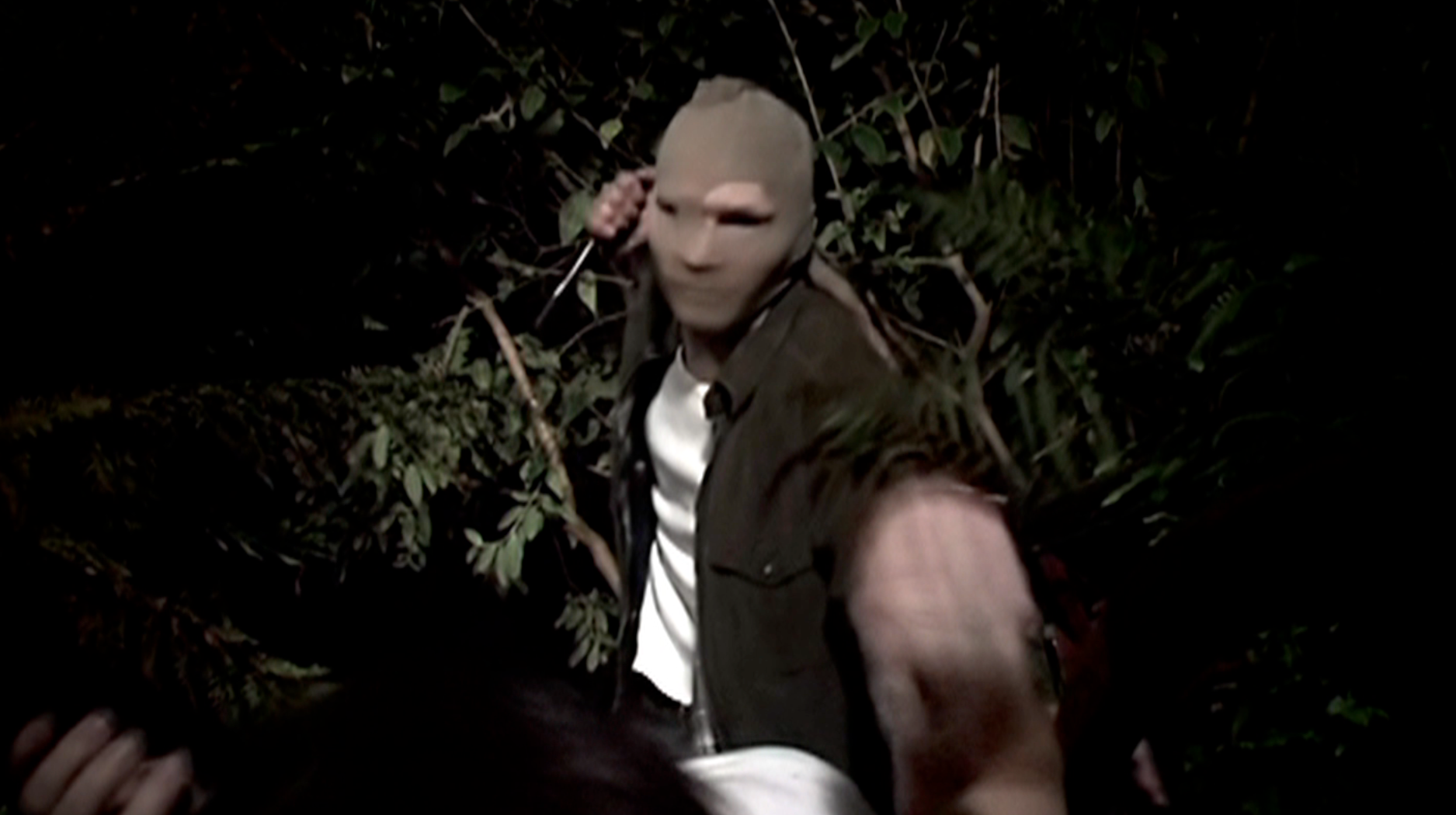
Eight women are dead. The latest victim was found two blocks away.
For one young couple, the news is disturbing enough. Then the phone begins to ring. A frightened voice begs for help. Someone they know is going to die tonight.
RAY REVELLO
BRIAN GRIMA
BRIAN GRIMA
Behind the Scenes
The origins of Number Nine can be traced directly back to The Corpse That Got Away. When Daryl showed that film to his father, Hank Della liked it, but immediately identified a basic setup problem in the ending. Daryl was irritated by the criticism, largely because Hank was right.
That conversation led to a simple thought. If Hank could look at one of their movies and so quickly see what the script was missing, maybe he should write one for them.
Number Nine became Hank’s first screenplay for Dollars & Donuts Productions and an attempt by Daryl and Ray to make something considerably more serious than the films surrounding it.
If Hank could see the problem that clearly, maybe he should write something for them.
Lorenzo Ocon was cast as the Killer, and the preparation for his appearance began long before the cameras rolled. Daryl and Ray asked him to grow his hair out for six months so they would have something substantial to destroy when it was finally time to create the character.
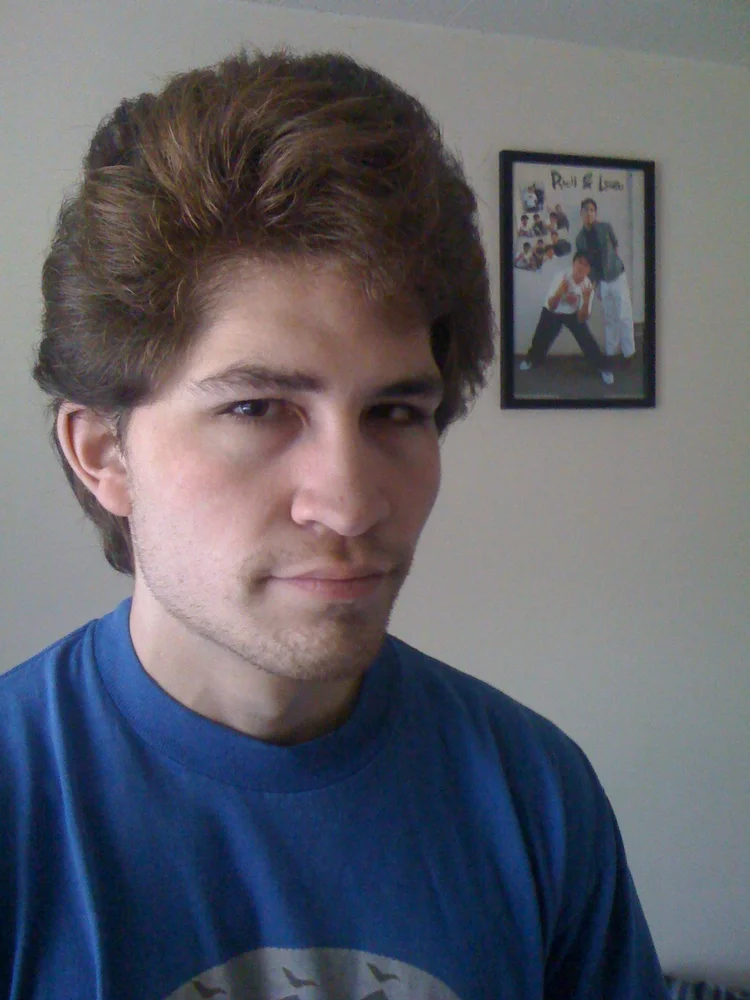
When the day finally came, Daryl, Ray, and Brandon J. Snyder attacked the haircut with very little interest in symmetry. They shaved sections in strange clumps, carved uneven patches into the sides, and kept making it worse until Lorenzo looked properly deranged.
There was only one thing he refused to let them touch: his eyebrows. Daryl asked him to close his eyes. One quick svvzzzz later, the eyebrows were gone.
For a moment Lorenzo didn’t react. Daryl, Ray, and Snyder stared at him, stunned that he hadn’t noticed, and started laughing. Lorenzo finally asked what was so funny. They told him to open his eyes.
He looked in the mirror and crumpled. “Those are my best feature!”
Daryl answered, “Were your best feature.”
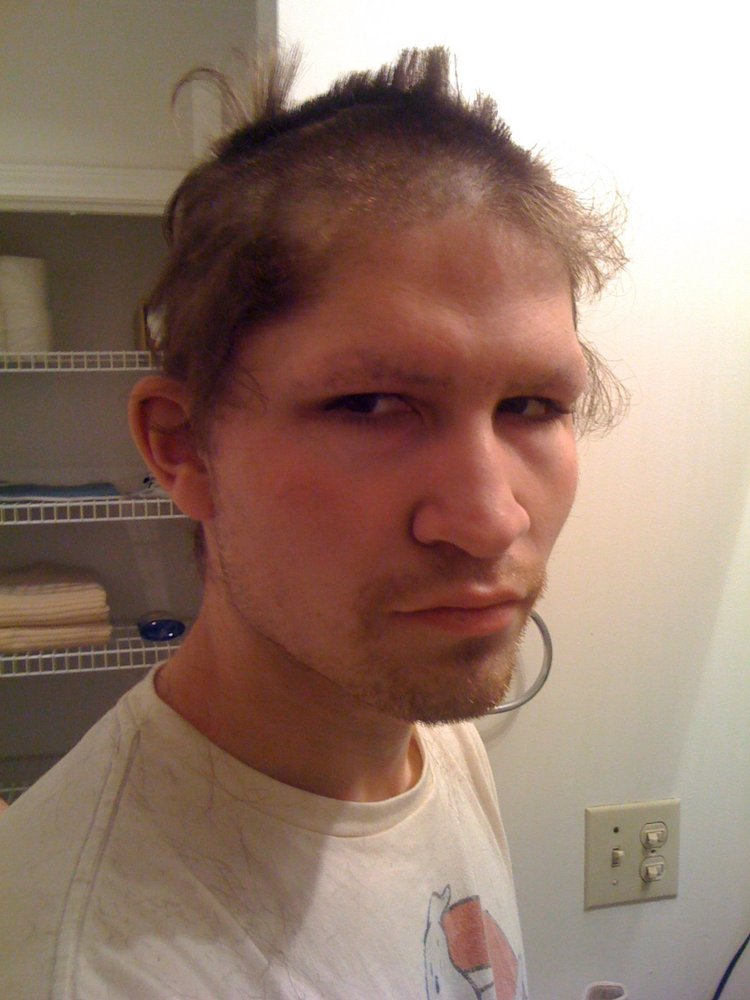
The joke had a long tail. Shooting was still months away, which meant Lorenzo had to maintain the mangled haircut and generally monstrous appearance while everyone waited for production to begin.
“Those are my best feature!”
“Were your best feature.”
When filming finally began, Daryl directed and shot the movie, with Ray Revello and Brian Grima handling lighting. James Hay played Jake, Kristin Mayer played Emily, Chris Cairo appeared as Jake’s brother Jimmy, and Lorenzo played the Killer.
After years of improvised comedies, prank films, action shorts, and stories built around whatever locations or props happened to be available, Number Nine represented an effort to slow down and approach the work differently. There was a complete screenplay. The performances were meant to be played seriously. Lighting was being considered in advance. The horror depended more on mood, suspense, and structure than on a joke waiting around the corner.
For Daryl, it also meant directing material written by his father. That alone made the project feel more substantial.
One of the first major problems had nothing to do with the actors. During an early night shoot, Daryl’s Sony HDV camcorder stopped working properly. The tape mechanism jammed in the open position, making the camera effectively unusable. He tried to fix it on the spot, then eventually sent it away for repair.
Brian Grima later remembered the moment because it was one of the first times he had seen Daryl become genuinely frustrated on a set. The anger wasn’t really about the machine itself. It was about being unable to make the movie.
The camera eventually came back from repair, but the problem never completely disappeared. The tape carriage continued to stick, and Daryl never trusted the camera again. He eventually replaced it, but by then one of the production’s first pieces of momentum had already been lost.
The camera came back. The trust didn’t.
By the time the central murder sequence was being filmed, the production had acquired a different kind of problem. Lorenzo was behaving strangely that night, keeping himself apart from the rest of the cast and leaning hard into the unsettling persona the group had spent months creating for him. That might have helped the character on camera. Off camera, he was being a creep toward Kristin and treating her poorly.
The scene required the Killer to physically attack and murder Emily, putting Kristin and Lorenzo in close contact for an already uncomfortable piece of material. As the night went on, the line between Lorenzo playing someone frightening and simply making Kristin uncomfortable became increasingly difficult to ignore. The shoot stopped.
As if that weren’t enough, the sequence was being filmed at night in the backyard of the Della family home on Holly Avenue. Kristin’s character was being murdered, which meant screaming. A lot of screaming.
After one scream too many, Hank opened the second-story window of his bedroom and yelled down for everyone to knock it off. The noise was carrying through the neighborhood, people were beginning to look over, and Hank had had enough. Daryl never completely understood the embarrassment. Hank had written the scene. He knew perfectly well what the script required.
But between Kristin’s discomfort, Lorenzo’s behavior, the attention from the neighbors, and Hank shutting down the backyard, the night was effectively over.
Hank had written the murder scene. Then he leaned out the window and told them to stop making so much noise.
Any one of those problems might have been recoverable on its own. Together, they drained the life out of the production.
The camera had failed. The lead actress no longer felt comfortable working through the murder sequence. The backyard location had become difficult to use. Months had already been spent preparing Lorenzo’s appearance for a reveal that still hadn’t been properly captured.
There was no single ceremonial moment when everyone declared Number Nine dead. It simply stopped. Enough footage survived for Daryl to later assemble a nine-minute incomplete version, including much of the setup and pieces of the later material, but the film never reached the story Hank had written.
The strangest part was how much preparation had gone into something that disappeared so quickly. Lorenzo had spent half a year growing his hair. The group had deliberately tried to improve the lighting, performances, structure, and tone. Hank had written a complete screenplay built around an actual narrative payoff. Then the production hit one miserable stretch and never recovered.
The incomplete film eventually appeared on Dollars & Donuts Archives: 2003-2010 in 2011, preserved less as a finished movie than as a record of where the group had been trying to go. The footage still shows that ambition. The pacing is quieter. The lighting is more deliberate. For once, the group was trying to build dread and sustain a serious tone rather than race toward the next joke.
But the production experience overwhelmed whatever enthusiasm had surrounded the project. Daryl didn’t come away wanting to immediately regroup and tackle another dark, serious film.
He wanted to make something else.
He wanted to make something else.