

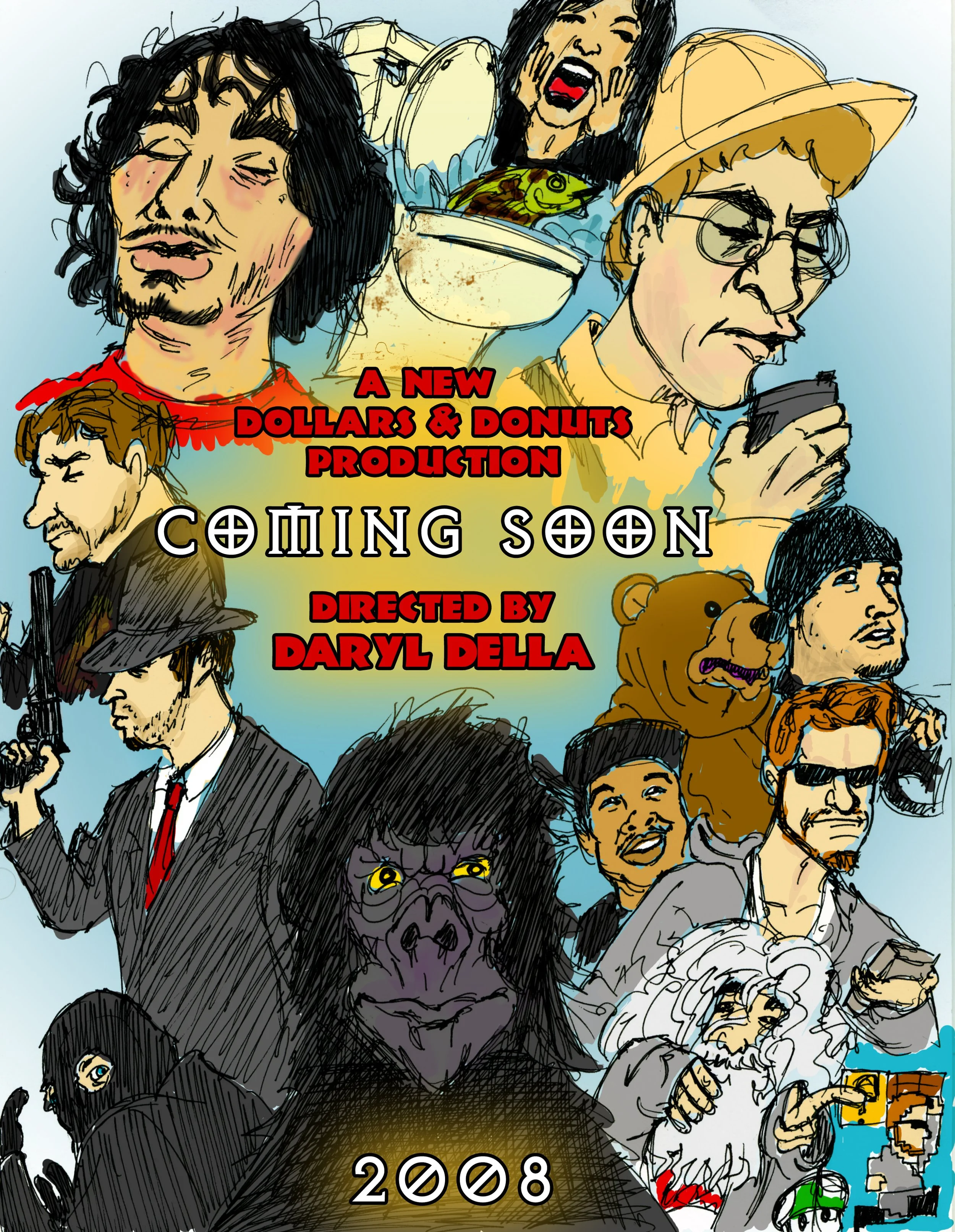
When the cast fails to show up, two filmmakers arrive at a solution: forget the story and make a movie out of completely different scenes with completely different people. Against all reason, that becomes the plan.
A conversation about wormholes gives way to an escaped gorilla, a hard-boiled detective hunting a killer through the night, spectacularly polite bank robbers, a strange man with a knife, and finally a gamer pursued across different forms of entertainment by the mysterious Don Juan Wizardo. Each scene leads somehow into the next, usually by the thinnest thread imaginable, until plot, genre, and reality itself become interchangeable.
Stream of Consciousness was never finished, but what survives plays exactly as promised: a movie with nowhere to go and an endless supply of ways to get there.
LORENZO OCON
Bayhill Shopping Center, San Bruno, CA
Blockbuster, South San Francisco, CA
Bluxome St, San Francisco, CA (Academy of Art)
Cypress Lawn Memorial Park, Colma, CA
El Camino High School, South San Francisco, CA
San Bruno CalTrain Station, San Bruno, CA
San Bruno Towne Center, San Bruno, CA
San Jose, CA
Sharp Park Beach, Pacifica, CA
South San Francisco, CA
Starbucks, Bayhill Shopping Center, San Bruno, CA
Behind the Scenes
Stream of Consciousness began less as a story than as an excuse to keep filming.
The practical problem was familiar. People were available at different times, actors could not always be counted on to return, and maintaining continuity across a longer production required more coordination than the group necessarily had. The solution was almost perversely simple: make a movie where every scene could have completely different characters.
That production problem became the concept.
One sequence could hand the movie to another through a prop, a location, a passing character, or the thinnest imaginable piece of connective logic. If somebody was available that afternoon, a scene could be invented for them. If a completely unrelated idea sounded funny, there was no reason it could not become the next five minutes of the movie.
That production problem became the concept.
The film even explains its own philosophy. When actors fail to arrive, the filmmakers on screen suggest making “a bunch of different scenes” so they never have to get the same people back more than once. The objection that there would be no story is quickly dismissed. Who watches their stuff anyway?
Without knowing it, the group had stumbled onto a structure similar to the one famously used by Mr. Show, where individual sketches bleed into one another through associative transitions. Nobody involved with Stream of Consciousness had seen Mr. Show at the time. The format simply emerged as a convenient way to film whatever they could, whenever they could.
There were supposed to be a few recurring threads holding the chaos together. The most important was an escaped gorilla, who would continue wandering through the film and periodically intrude upon otherwise unrelated scenes. Another running gag involved the familiar Super Mario Bros 1-Up mushroom, repeatedly appearing across different scenes accompanied by its little 1-Up jingle.
But the more interesting continuity came from the characters.
Frank Barnett and Ninja Killface were folded into the project, while Jack Knife and Bud & Lou were created specifically for it. As production continued, some of these segments began to feel too substantial to remain pieces of a larger unfinished experiment. They were pulled out and developed into films of their own.
The connections remained visible. Frank Barnett appears in the eventual Bud & Lou short. Ninja Killface turns up in Jack Knife vs. the Gorilla. The escaped gorilla, originally intended as Stream of Consciousness' recurring connective tissue, effectively wandered out of the unfinished movie and into another one.
That makes the surviving footage less of a dead end than it initially appears. Stream of Consciousness failed to become a finished film, but pieces of it kept reproducing elsewhere.
Pieces of it kept reproducing elsewhere.
Stylistically, the project gave the group permission to try almost anything. Noir parody, bank robbers, horror, fantasy, video games, established characters, newly invented ones, and whatever else sounded entertaining could coexist because incompatibility was built into the premise. There was no need to ask whether an idea belonged in the movie. The movie existed specifically to give ideas somewhere to go.
That freedom was also its greatest weakness. There was no natural ending, no fixed cast forcing production forward, and no real limit on how many new sections could be added. A movie designed to accommodate anything could theoretically continue forever.
Eventually, it simply stopped.
But several of the characters did not. Stream of Consciousness became something more useful than the film it was supposed to be: a testing ground where ideas could appear briefly, survive contact with the camera, and escape into the larger Dollars & Donuts universe.