

ninja killface II: die killface die
Revenge ignites anew as the Killface saga continues with a shocking twist: Aries Lansing is alive. The merciless Mr. Revolver won't rest until Killface is defeated, unleashing lethal hitmen Jabber Calibax and Chuck Morris to end the chase. After a devastating betrayal and a deadly showdown on Sign Hill, Killface retreats to South Lake Tahoe, honing his skills for the inevitable final confrontation. Swords clash and fates are sealed in the chilling climax amidst the serene woods of Lake Tahoe. Brace yourself for an action-packed sequel filled with thrills, spills, and vengeful chills.
Credits
Directed by
DARYL DELLA


CAST

NATHAN BLONKENFELD as Ninja Killface

RAY REVELLO as Mr. Ray Revello

DONALD FLORES as Chuck Morris

BRANDON J. SNYDER as Jabber Calibax

KIRSTEN OLSEN-DAVIS as Aries Lansing

DARYL DELLA as Bum #1

LORENZO OCON as Bum #2

RICHARD CASTROMAYOR as Rude Jerk

JENNIFER DUMPIT as News Anchor

BRUCE CUMMINGS as Himself

SHIRLEY DEVI, VICTOR BAUTISTA, & KELVIN PHANG as News Crew


Fake Shemps
DARYL DELLA
BRANDON J. SNYDER

Stunt Performers
NATHAN BLONKENFELD
DONALD FLORES

Executive Producers
DARYL DELLA
RAY REVELLO
NATHAN BLONKENFELD

Screenplay
RAY REVELLO

Cinematographer
DARYL DELLA

1st Assistant Camera
RAY REVELLO

2nd Assistant Camera
BRANDON J. SNYDER

Makeup Artist
DARYL DELLA

Weapons Master
NATHAN BLONKENFELD

Location Manager
DARYL DELLA

Transportation Captain
DARYL DELLA

Assistant to Mr. Della
DONALD FLORES

Assistant to Mr. Blonkenfeld
RAY REVELLO

Assistant to Mr. Revello
NATHAN BLONKENFELD

Editor
DARYL DELLA

Foley
DARYL DELLA

Special Visual Effects
DARYL DELLA

Graphic Design
DARYL DELLA
BRANDON J. SNYDER

Titles
DARYL DELLA

Score by
GRAEME REVELL, ENNIO MORRICONE, TERRY PLUMERI, MARCO BELTRAMI, JOHN WILLIAMS, ALAN SILVESTRI, DANNY ELFMAN, GIUSEPPE VERDI

Score Edited by
DARYL DELLA


SONGS

"All My Life"
FOO FIGHTERS

"Faint"
LINKIN PARK

"The Way I Am"
EMINEM

"Come Fly with Me"
FRANK SINATRA

"In the End"
LINKIN PARK

"Sleep Now in the Fire"
RAGE AGAINST THE MACHINE

"My Way"
FRANK SINATRA

"One Fine Day"
THE OFFSPRING


Shot with
SHARP VIEWCAM VL-H860
SONY HANDYCAM DCR-HC20

Filmed Entirely on Location in
COLMA, CA
SAN BRUNO, CA
SAN FRANCISCO, CA
SOUTH LAKE TAHOE, CA
SOUTH SAN FRANCISCO, CA
STATELINE, NV

Special Thanks
KIRSTEN OLSEN-DAVIS
MOM & DAD
GRANDMA & PA
TYLER DELLA
AUNTIE LINDA
JOSHUA NAIR
CHRIS CAIRO
JONATHAN CAIRO
HEATHER BLONKENFELD
MARY-LIZ GUTHIER
Poster
by Alex Niño & Nathan Fox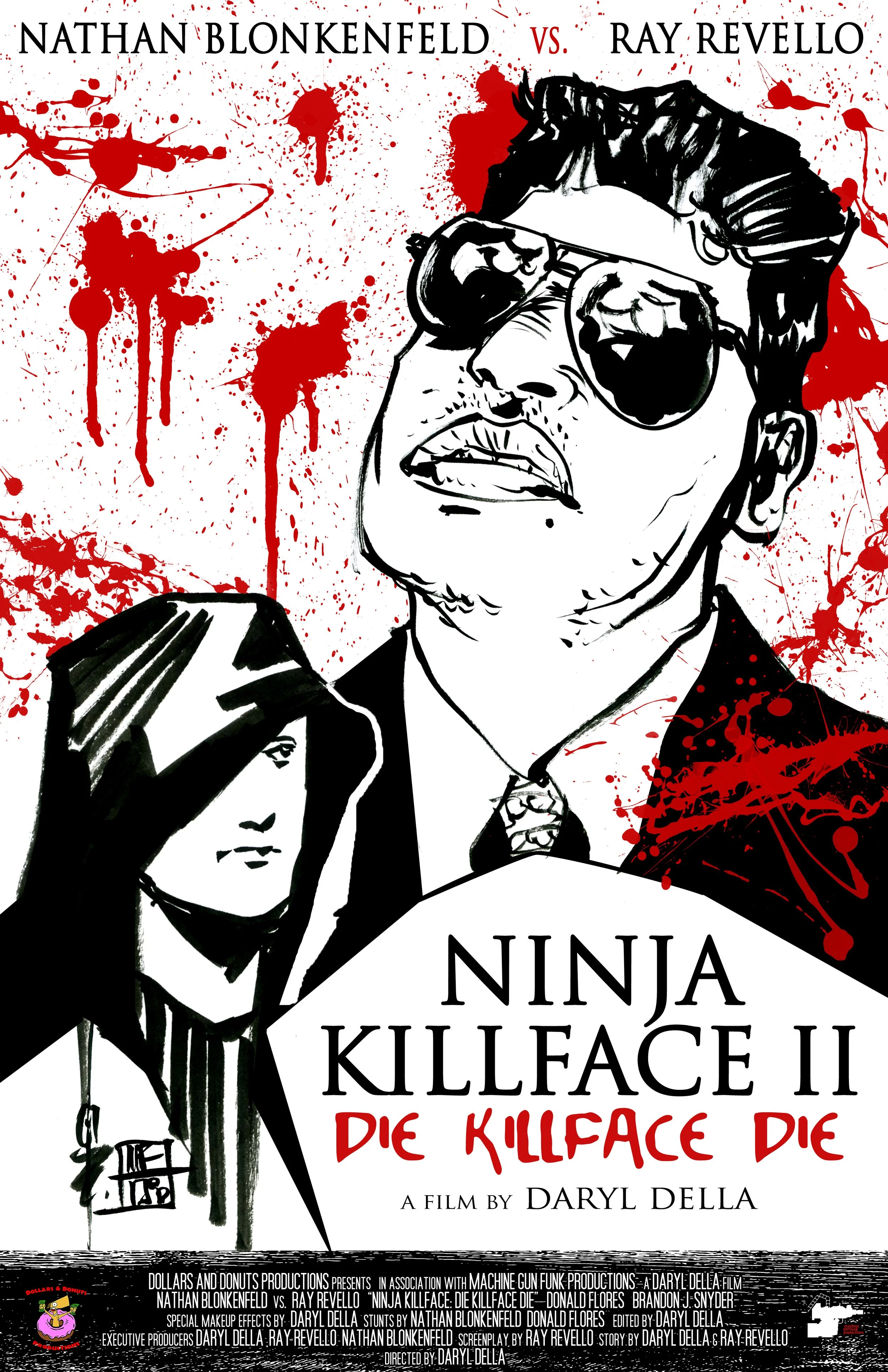
Characters
-

Ninja Killface
NATHAN BLONKENFELD
-

Mr. Ray Revolver
RAY REVELLO
-

Aries Lansing
KIRSTEN OLSEN-DAVIS
-

Bruce Cummings
BRUCE CUMMINGS
“I’ll get you Ninja Killface! If it’s the last thing I do!”
Mr. Ray Revolver, Ninja Killface II: Die Killface Die
By 2005, Ninja Killface II marked a turning point for Dollars & Donuts Productions. It was their most ambitious undertaking to date, born from a simple instinct that arrived too early.
The idea for a sequel came before the first film was even finished. On the way to shoot a garage scene for Ninja Killface, Daryl pitched it to Nate. The title came first. Ninja Killface II: Die Killface Die. Stolen outright from Darkman III. Nate rolled his eyes and called it stupid. That could have been the end of it, if the director was anybody else.
At one point, the sequel wasn’t even a sequel. There was a full detour into a vampire film. Nate wrote an outline. Daryl turned it into a script. The story followed a detective named Blight McCreek retreating to Tahoe and stumbling into a nest of vampires. It had locations. It had momentum. It had a future. Then Nate bailed on the Tahoe trip.
Daryl went anyway, drove around with Auntie Linda scouting locations, and somewhere between the empty woods and the absence of a collaborator, the enthusiasm died. The script was later lost in an iMac crash, which in retrospect feels less like a tragedy and more like the movie quietly choosing not to exist.
The real turning point came in a movie theater. Freddy vs. Jason hit like a revelation. Daryl and Ray had already spent months talking about it in Mary-Liz Guthier’s English class, usually when they weren’t supposed to be. After seeing it, the conversation shifted. It wasn’t just admiration anymore. It was a challenge. They wanted that final fight.
Not something like it. That exact feeling. Two forces colliding, escalating past logic into something bigger than the movie itself. That became NK2.
The structure followed instinct, not design. There was a three-page script written by Ray. It covered the beginning and the end. Everything in between had to be discovered the hard way. Scenes were shot because they could be shot. Meaning was applied later. If a fight existed, a reason would be invented. If a character appeared, a backstory would follow. It was backwards filmmaking.
Production stretched across more than a year, drifting between South San Francisco and South Lake Tahoe. Continuity didn’t stand a chance. Hair changes. Weight fluctuates. Locations jump mid-sequence. Cameras switch shot to shot. Scenes filmed a year apart sit next to each other without apology. Nobody was trying to hide it. They were trying to finish the movie.
There were long stretches where it looked like they wouldn’t.
Originally, the plan was simple. Go up to Tahoe for a weekend. Shoot the entire final battle. Finish the movie. But, Nate bailed again.
Instead of a climax, they got footage of Ray wandering through the woods looking for someone who wasn’t there. At the time, it felt like another delay. In hindsight, it saved the movie. That version of the fight would have been rushed, small, forgettable. This forced them to think bigger.
Back in South San Francisco, the film began to expand. Daryl filled notebooks during Tech Lab instead of doing classwork, sketching out ways to make the movie longer, stranger, more layered. Killface would train an apprentice. Revolver would hire outside help. Aries Lansing would return and complicate the final battle.
Most of it didn’t survive.
Kirsten declined to return, which quietly killed the Aries subplot. Other ideas fell away as the reality of production set in. What remained was the spine. Revenge. Training. Collision.
The apprentice role evolved into Chuck Morris. Originally intended for Rich Castromayor, the part shifted to Donald. The name came from Donald’s brother, Sal, and stuck immediately. That was the level of deliberation.
Donald’s introduction changed the movie. The fight on Sign Hill between Killface and Chuck wasn’t just another scene. It raised the bar. Suddenly the final fight had to match it, or exceed it. That’s when the movie started demanding more than it could comfortably deliver.
The physical toll was real too. Nate took a fall on Sign Hill and tore his hand open. He accumulated injuries across the entire run. Bruises. Cuts. A wrecked knee. Sword hits. Close punches. At one point, he was nearly hung by his own costume.
And then there was Tahoe. After a full day of running up and down the street in costume, they moved into the woods to shoot the final fight. During one take, Ray’s punch connected clean. Nate went down and didn’t get up. For a moment, everyone thought he was committing to the bit. He wasn’t, he was out cold. They finished the scene the next day.
The film kept growing in strange directions. A fake commercial for a generic soda called Duo was shot because the group found the brand inexplicably hilarious. The cans appear throughout the movie, unmotivated and unexplained.
Richa still appears briefly, getting punched out in Ray’s garage. A ghost of an earlier version of the story. Scenes were added, reshaped, or abandoned based on availability, energy, or boredom. It was less a production than a moving target.
Technically, the film marks a leap. Daryl’s old system couldn’t handle the scale anymore. The project had to be edited in fragments, barely holding together. Then came the upgrade. A G5 with Final Cut Pro, a graduation gift from his parents that changed everything.
For the first time, the movie could be finished properly. Effects improved. Editing tightened. The film gained a level of polish that earlier projects couldn’t reach, even if the underlying footage remained chaotic. Years later, Daryl would revisit the film again, adding effects, fixing things that had always bothered him, and leaving others untouched because removing them would erase the film’s identity.
The environments were whatever they could access. Public spaces were used without permits, including scenes involving visible weapons. In Tahoe, neighbors called the police after seeing Nate running through the street with sais. Daryl’s parents explained just enough to keep the boys going.
Off camera, the group dynamic was just as volatile. The forum posts from the time read less like planning documents and more like a running argument. Everyone wants a DVD. Everyone insults everyone else. Nate calls out his own acting before anyone else can. Donald fires back. Ray escalates it into something theatrical. It’s not hostility. It’s rhythm. The movies are an extension of that.
Ninja Killface II premiered in 2005 and became something bigger than expected. Mary-Liz Guthier screened it for her classes year after year. Students didn’t always follow the story. They didn’t need to. They responded to the energy, the commitment, the sense that something real was happening even when nothing made sense. And they always asked the same question.
When’s part three?
Looking back, Ninja Killface II sits at the exact point where everything starts to shift. It’s still reckless. Still improvised. Still held together by instinct and stubbornness. But there’s something else creeping in. Ambition. You can see the moment where the group realizes what they’re trying to do, even if they don’t yet know how to do it. It’s not the peak. It just felt like it at the time.