

WHEN STARS ARE BRIGHT
Two brothers. One backyard. Infinite stars.
On a balmy summer night, Chase and Tommy settle in with popcorn and wishes, expecting nothing more than a late bedtime and a few shooting stars. But when the sky begins to move in ways it shouldn’t, their quiet backyard campout turns into a close encounter of the childhood kind.
Credits
Directed and Edited by
DARYL DELLA
Written by
J. PHILLIP WILKINS
and
DARYL DELLA
Starring
HENRY ETHAN DELLA as Chase
ELIAS DALTON DELLA as Tommy
Produced by
KIRSTEN DELLA
Poster
by Daryl Della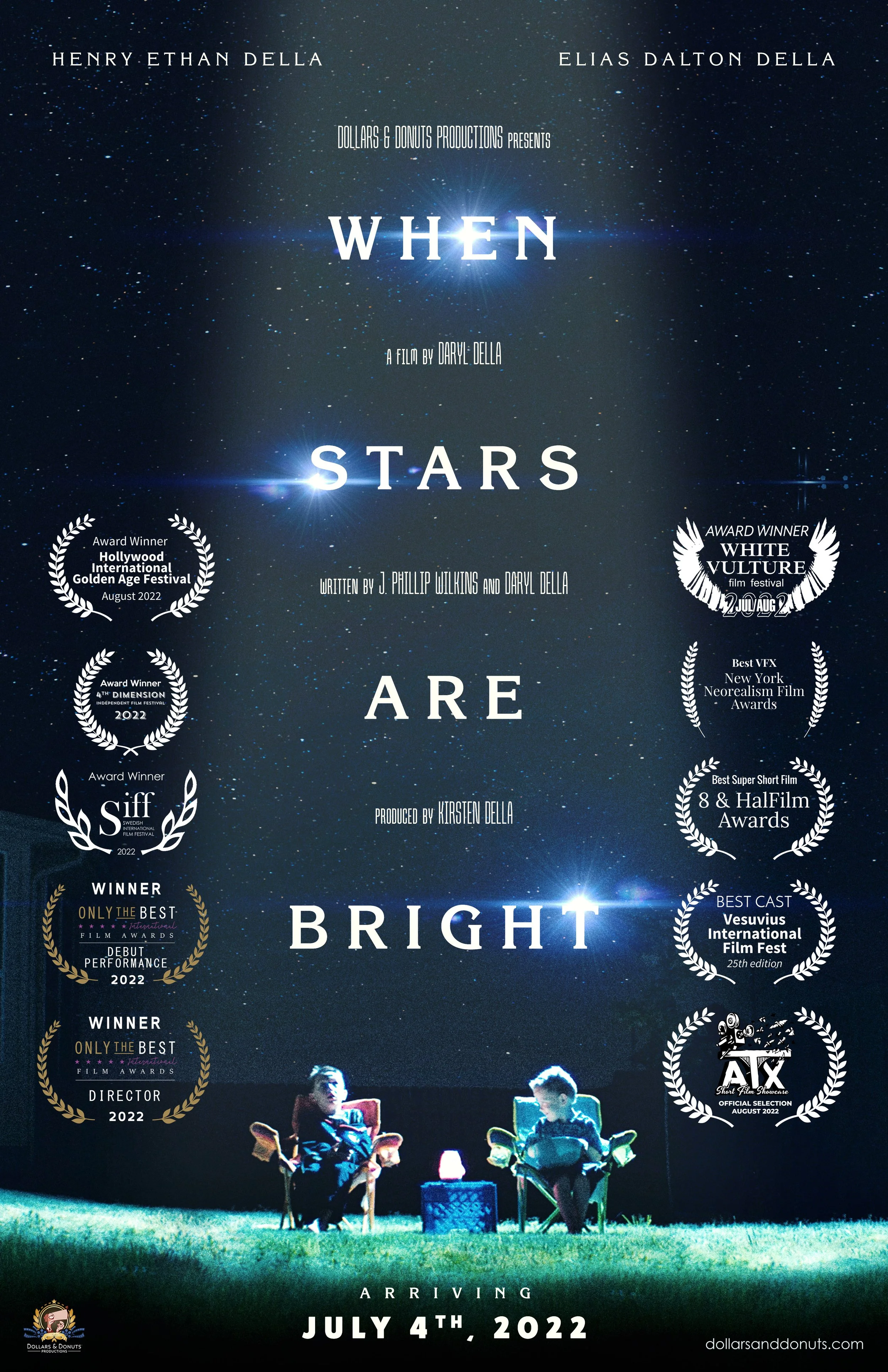
Behind the Scenes
The film began less as a narrative ambition and more as a technical itch. Eager to test a set of Orion anamorphic lenses that had just become available for rental, Daryl Della decided the best subjects for a lens test would be the two people least likely to complain about multiple takes: his sons, Henry and Eli, then six and four years old.
Searching for a suitable foundation, Daryl combed through Script Revolution and found a short script by J. Phillip Wilkins, with whom he had already established a productive relationship through scripts such as Tipsy and the long-gestating New Age Enema. The original story centered on teenage boys and did not feature any UFO element, but Daryl immediately saw the bones of something more personal. Wanting to tailor it to his young sons and build around a visual effects challenge he had been itching to attempt, he quickly rewrote the script and reached out to Wilkins for permission.
The timing was less than ideal.
By the time permission was formally requested, the anamorphic lenses were already on their way and Daryl had more or less emotionally committed to the rewrite. Fortunately, Wilkins agreed, narrowly saving the production from becoming an expensive lens test with no film attached.
The shoot was split across two nights to avoid exhausting the boys, with Daryl and Kirsten Della carefully shaping the production around the rhythms of family life. The boys loved the novelty of staying up late in the backyard eating popcorn and playing under the lights. Eli, still very young, often had only a vague sense of what the film was supposed to be, which allowed Daryl to lean into his natural reactions and unfiltered presence. Henry, by contrast, quickly proved himself a natural mimic, able to mirror line readings and emotional beats once Daryl demonstrated them. At that age, neither child had yet developed any self-consciousness in front of the camera, making their performances unusually pure and instinctive.
The film’s signature abduction effect was achieved through a mix of ingenuity and brute-force patience. Lacking a spotlight powerful enough to flood the yard with the kind of Spielbergian white light Daryl envisioned, the same Aputure light was repositioned and shot repeatedly across multiple passes, with the frames later composited into a single exposure. For the final abduction shot, smoke was pumped across the yard while Daryl physically lifted Henry overhead by the back of his shirt before painstakingly rotoscoping himself out in post-production. The result is one of the most striking visual effects in the Dollars & Donuts catalog, especially given its homespun origins.
A lovely detail from the period found its way directly into the dialogue: Eli was then deeply obsessed with “hunting turkeys,” and this became one of the film’s most charming lines, with his wish for a turkey standing in amusing contrast to the cosmic events unfolding above him.
One of the film’s more unexpectedly poignant aftershocks lies in the dialogue itself. At the time, Daryl and Kirsten could perfectly understand the boys’ half-formed child speech, hearing every line with crystal clarity. Audiences at early screenings, however, often struggled to decipher what the children were saying. Years later, the strange irony is that the boys’ once-familiar baby cadences have become almost as unintelligible to their own parents as they were to everyone else at the time. Time, as the film itself suggests, has a way of turning the familiar into something mysterious.
Beyond its technical achievements, When Stars Are Bright marked an important personal and professional turning point. The partnership with Michael Martin had not yet formally dissolved, but the fault lines were already beginning to show. After completing the short, Daryl sent the finished film over and asked the simple question: What do you think? The response came back just as plainly: “It’s a movie.” In retrospect, that moment of indifference now reads as one of the straws that broke the camel’s back. Here was a complete piece of work. Conceived, shot, and finished with family, instinct, and sheer force of will, and it was met with a shrug. More than just a successful short, When Stars Are Bright became proof that Daryl still had the ability to conceive, execute, and finish a complete cinematic work on his own terms, without the larger structure that had defined the previous era of Dollars & Donuts.
The film quickly became a breakthrough on the Austin festival circuit. Its inclusion in the ATX Short Film Showcase introduced Dollars & Donuts to a new generation of Austin collaborators and creatives, many of whom would soon become part of the company’s orbit. The short later returned for the festival’s Best of the Year program, where it won Best Visual Effects, further cementing its reputation as a deceptively small film with outsized craft. A screening at Austin Under the Stars expanded that reach even further, effectively announcing Dollars & Donuts’ arrival on the Austin indie scene.
Small in scale but complete in execution, When Stars Are Bright remains one of the most elegant and quietly moving films in the catalog: a family project, a technical flex, and a creative rebirth all at once.
Characters
-

Chase
HENRY ETHAN DELLA
-
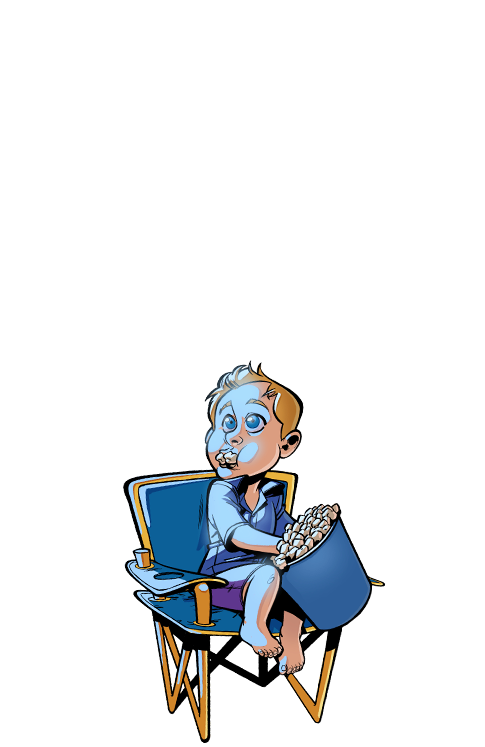
Tommy
ELIAS DALTON DELLA