
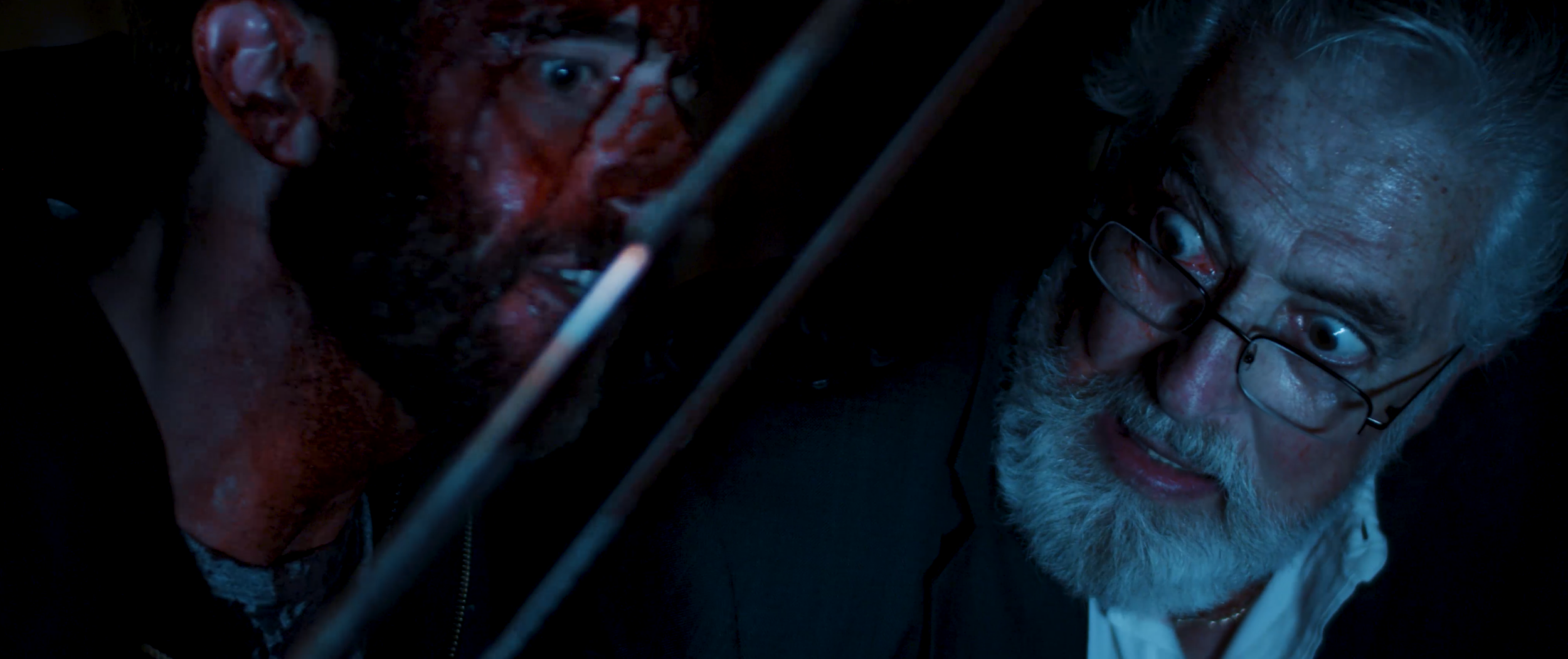
dead right: Part three
Deke Trenton emerges as a relentless force in a world ruled by betrayal and blood debts, methodically taking down those who cross him. After a brutal confrontation leaves three bodyguards dead, Deke confronts Mr. Rooker, his once-trusted ally turned adversary, in a chilling showdown that culminates in ruthless retribution. As the tension peaks, the sudden call from Deke's brother, Bennie, sets the stage for a brutal family feud that threatens to consume them all.
Characters
-

DEKE TRENTON
MICHAEL. MARTIN
-

ROOKER
JACK LEWKOWITZ
-

Bennie TRENTON
MITCHELL MARTIN
The Dead Right Series
Brutal. Ruthless. Deadly. He’s flawed that way. Deke Trenton's relentless quest for justice unfolds across three gripping chapters. Framed by his brother and forced into a treacherous world of betrayal and vengeance, each film escalates Deke’s battles, pushing him to the brink. From sinister clinics to deadly confrontations, explore Deke’s journey in the Dead Right series, where his flaws might just be his salvation.
the chronicles of Rooker
Mr. Rooker's story weaves through the darkest corners of crime and retribution. From his cold-blooded dealings in A Lovely Place to Die to the twisted justice of The Alibi, follow the chilling path of an enforcer who writes his own rules.
Behind the Scenes
By 2017, Dead Right III was the elephant in the room. The trilogy demanded a conclusion, but the sheer scale of producing a feature-length action film was a wall Michael Martin refused to climb. Recognizing that his partner would never sign off on the massive budget and schedule required for a full greenlight, Daryl Della attempted a tactical workaround: he tried to trick Michael into making the movie one piece at a time.
Daryl’s strategy was simple: shoot the prologue first as a standalone segment. Once that was in the can, he hoped the footage would serve as a catalyst—reigniting Michael’s excitement, stoking his ego, and creating enough momentum to justify shooting the next scene, and then the next. It was an attempt to bypass the paralysis of "Feature Filmmaking" by gamify-ing the production, turning a daunting mountain into a series of manageable molehills.
The strategy failed. Michael saw through the maneuver immediately, telling Daryl bluntly, "I know what you're trying to do." He was vehemently opposed to the piecemeal approach, viewing it as unprofessional or chaotic. Instead of seeing the prologue as a stepping stone, he saw it as a trap designed to drag him into a commitment he didn't want to make.
He demanded the traditional "Hollywood" approach—a full script, a finalized budget, and a complete schedule before a single frame was shot. In the context of Dollars & Donuts' scrappy history, this insistence on formal structure acted as a gatekeeper. By demanding a process he knew was impossible for their resources, Michael effectively pocket-vetoed the film.
Despite the resistance, the Prologue was filmed. It stands today as the only existing footage of the finale—a fragment of a story that was doomed by the apathy of its lead producer. Daryl’s hope that the footage would spark joy in his friend was dashed; Michael remained unmoved, and without his buy-in, the momentum died instantly. The production wrapped not with a "See you next week," but with silence.
The tragedy of Dead Right III is not that it was too big to fail, but that Daryl Della was willing to make it small enough to succeed, and still received silence in return. By May 2020, the dream of a feature-length blockbuster had been shelved. In a final act of creative bargaining, Daryl took his sprawling, violent epic and surgically reduced it. He cut the script down to a lean, manageable 26 pages—a runtime that could be shot over two weekends.
He sent the email to the core trio—Michael, Mitchell, and Ray—pitching this condensed version not as a burden, but as a victory lap. "We could totally get this version done," he wrote, noting that the first six pages (the Prologue) were already in the can. It was a silver-platter offer: the glory of finishing the trilogy with a fraction of the work.
The response was a deafening silence. There were no arguments, no counter-offers, and no negotiations. Just a void. The "receipt" of that unanswered email stands as a monument to the partnership’s end. It proved that the issue was never about the budget, the schedule, or the script length. It was about will. Daryl was willing to compromise his vision to cross the finish line; Michael was unwilling to walk the track.