

Rupert’s Word
Trust the plan.As Rupert drifts deeper into his own fractured routine, the world around him begins to feel less like reality and more like a waking fever, punctuated by a strange recurring mantra that seems to promise meaning while delivering only unease. Part suburban reverie, part absurdist psychological sketch, Rupert’s Word is a deliberately elusive experiment in monotony, madness, and the strange poetry of everyday life.
Directed and Edited by
DARYL DELLA
Written and Produced by
CHRIS CAIRO
Starring:
CHRIS CAIRO
Camera: CANON EOS 550D - REBEL T2i
Shot on location in Lake Forest, CA
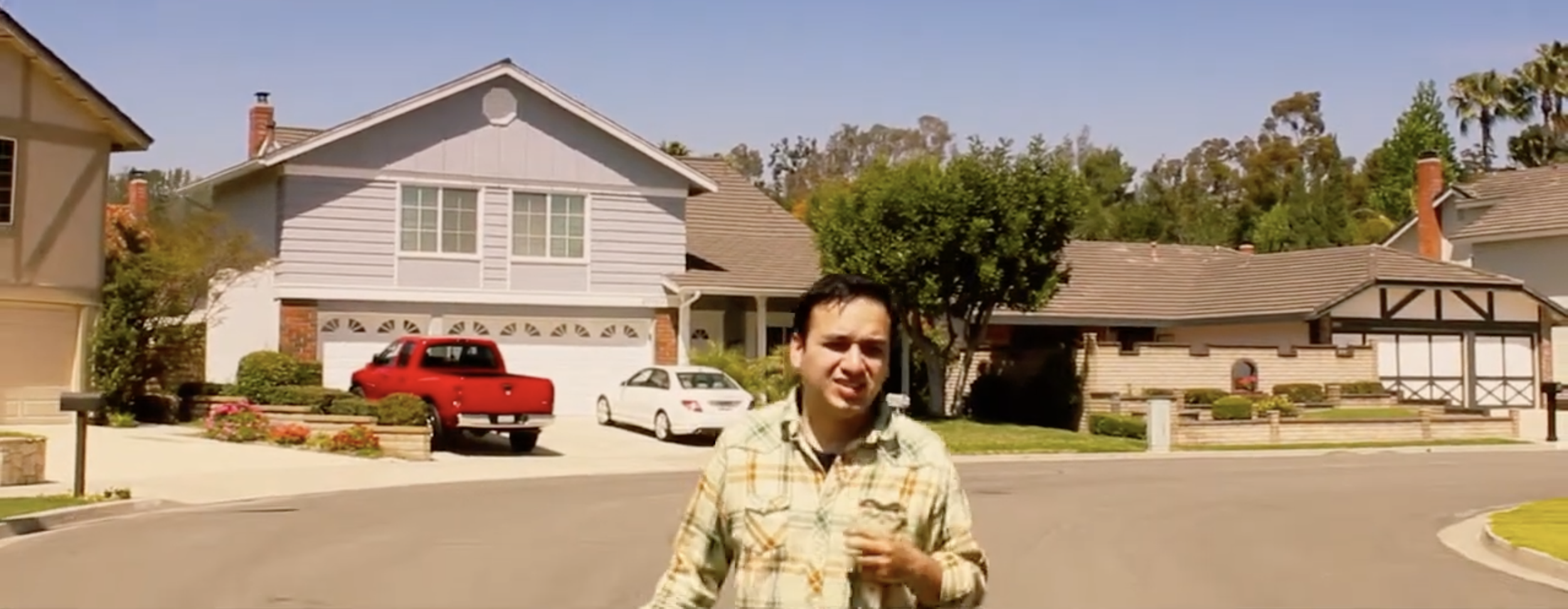
Behind the Scenes
Shot in Lake Forest, California, Rupert’s Word emerged during a transitional period for Daryl Della, who had recently moved south to work at Clear Creative Media under Ryan Neisz, serving as editor and resident jack-of-all-trades. The move dropped him into an entirely new visual landscape: immaculate streets, sun-drenched trees, and the kind of pristine suburban architecture that stirred real aspiration. Those morning walks to work through the neighborhood seeped directly into the film’s DNA, most notably in the tracking shots following Rupert through the streets, captured with a suction-cup rig mounted to the front of Daryl’s truck. They remain some of the short’s most memorable images and, in retrospect, an early cinematic love letter to the idea of someday building a home and life of his own.
The production itself was sparked by Chris Cairo, who was visiting Los Angeles on a work trip and extended his stay to make something together. Energized by the experimental spirit of Stagnation, Cairo was eager to keep the momentum going. At the time, he had floated the gloriously overambitious idea of writing fifty-two scripts and producing a short every week, a notion Daryl was more than willing to entertain in theory, if not always in practice. Where Michael Martin often represented planning and deliberation, Cairo brought speed, instinct, and a kind of restless creative urgency that bordered on mania. Daryl often found himself pulled between those two forces, each representing a different side of his own artistic instincts.
“the product of the work both great and small, filled the designer’s plan”
True to Cairo’s impulsive streak, Rupert’s Word was largely conceived on the spot. The opening once again falls into the dreaded “alarm clock wake-up” trope, something Daryl had already come to resent after Stagnation, but the short quickly veers into stranger territory. One key creative choice gave the piece its surreal flavor: Cairo would perform every role in the film. This allowed Daryl to experiment with split-screen composites and double performances, lending the project a fractured internal logic that perfectly suited its dreamlike tone.
The magic iguana came from Ryan Neisz’s studio, a prop Daryl had to specifically call and request permission to borrow. According to studio lore, the iguana had been salvaged from Ryan’s earlier days as a production assistant on professional sets, possibly from Kramer’s apartment from Seinfeld, though the provenance has always remained hazy. In a way, that uncertainty feels perfectly suited to the film itself.
Rupert’s peculiar muttering and social dislocation were directly inspired by longtime Dollars & Donuts fixture Lorenzo Ocon, whose eccentric habits and off-kilter rhythms had long made him an unforgettable presence within the company’s orbit. The repeated phrase, “the product of the work both great and small, filled the designer’s plan,” was pulled from an obscure poetry database by Cairo, chosen less for meaning than for its vaguely biblical unease. Its function was tonal rather than narrative, lending the short an atmosphere of ritualistic nonsense. Likewise, the voice of the iguana was performed as an affectionate impression of the group’s former high school drama teacher, Mr. Crockett, a mentor figure who remained an important influence on Cairo’s artistic sensibilities.
More than anything, Rupert’s Word now plays as a perfect time capsule of Cairo’s strange artistic streak. He possessed a relentless need to make things, but often seemed equally fascinated by the performance of what an artist ought to look like.
One story from the period captures the spirit perfectly. During a visit to his San Francisco apartment, Daryl and Ray Revello watched with growing amusement as Cairo dramatically hauled a canvas onto the roof with the grand intention of painting the skyline like some idealistic bohemian in his own head. The idea of it was intoxicating: the artist on the rooftop, city sprawling behind him, brush in hand, the whole tableau screaming importance. The only problem was that he wasn’t any good at painting.
That was always part of Cairo’s charm.
He had a gift for bullshit, but the first person he was usually bullshitting was himself. He was often too smart to fully believe his own pose for long, which meant the performance would eventually collapse under its own weight. Halfway through, after producing something that looked less like San Francisco and more like a chimpanzee’s fingerpainting, Cairo stopped, stared at it, and admitted, “this sucks actually.”
That, in many ways, is Rupert’s Word.
It’s half-assed art for its own sake, made with total conviction and just enough self-awareness to survive its own pretensions. A film less concerned with saying anything concrete than with the glorious act of making something because the impulse struck on a Tuesday afternoon. Half-experiment, half-mood piece, half-inside joke. Yes, that’s three halves.
Among the inner circle, the reception was less than ecstatic. Cairo would later jokingly refer to Rupert’s Word as “my first flop.” The phrase stuck because it perfectly suited the image: Cairo as failed auteur, mourning a tiny suburban psychodrama that only a handful of people had even seen.
In that sense, the short stands as a document of a particular phase: a period of young filmmakers reaching for seriousness, stumbling into cliché, yet still discovering flashes of genuine visual language along the way. Like much of this era, it is a collision between aspiration and improvisation, cliché and invention, self-importance and self-mockery.
In other words, pure Dollars & Donuts.
Characters
-

Magic iguana
CHRIS CAIRO
A figment of Rupert's imagination or something far worse, the Magic Iguana is a malevolent force, telepathically commanding him toward fear, chaos, and unsettling self-discovery.